2015年10月28日 星期三

Western Literature Week 7

Myth
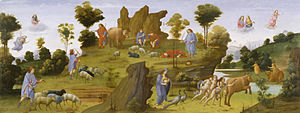
The ancient Roman poet Ovid, in his "The Metamorphoses," told the story of the nymph Io who was seduced by Jupiter, the king of the gods. When his wife Juno became jealous, Jupiter transformed Io into a heifer to protect her. This panel relates the second half of the story. In the upper left, Jupiter emerges from clouds to order Mercury to rescue Io. In the lower left, Mercury guides his herd to the spot where Io is guarded by the hundred-eyed Argus. In the upper center, Mercury, disguised as a shepherd, lulls Argus to sleep and beheads him. Juno then takes Argus's eyes to ornament the tail feathers of her peacock and sends the Furies to pursue Io, who flees to the Nile River. At last, Jupiter prevails on his wife to cease tormenting the nymph, who, upon resuming her natural form, escapes to the forest and ultimately becomes the Egyptian goddess Isis
A myth is any worldview-based traditional story, collection or study. It is derived from the Greek word mythos, which simply means "story". Mythology can refer either to the study of myths, or to a body or collection of myths.

X/z/enia
X/z/erox copy (carbon dioxide→C.C.)

Q-lip
Cotton swabs (American) or cotton buds (British) consist of a small wad of cotton wrapped around one or both ends of a short rod, usually made of either wood, rolled paper, or plastic. They are commonly used in a variety of applications including first aid, cosmetics application, cleaning, and arts and crafts.

Tampon
A tampon is a mass of absorbent material, primarily used as a feminine hygiene product. Historically, the word "tampon" originated from the medieval French word "tampion", meaning a piece of cloth to stop a hole, a stamp, plug, or stopper. At present, tampons are designed to be easily inserted into the vagina during menstruation and absorb the menstrual flow.

Kotex
「Kotex」的圖片搜尋結果
Kotex is a brand of feminine hygiene products, which includes the Kotex maxi, thin and ultra thin pads, the Security tampons, and the Lightdays pantiliners.

Rage: Outrageous/Fury/Angry
A bird of prey→Prey, Predator
Elegy: A short liris poem that related to
Eulogy(eu: good)

2015年10月21日 星期三

Western Literature Week 6

Penelope's weaving
In Homer's legend of the Odyssey, Penelope the faithful wife of Odysseus was a weaver, weaving her design for a shroud by day, but unravelling it again at night, to keep her suitors from claiming her during the long years while Odysseus was away; Penelope's weaving is sometimes compared to that of the two weaving enchantresses in the Odyssey, Circe and Calypso. Helen is at her loom in the Iliad to illustrate her discipline, work ethic, and attention to detail.

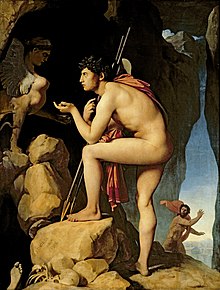
Oedipus complex
Oedipus, who unwittingly kills his father, Laius, and marries his mother, Jocasta.
The term Oedipus complex (or, less commonly, Oedipal complex) explains the emotions and ideas that the mind keeps in the unconscious, via dynamic repression, that concentrates upon a child's desire to have sexual relations with the parent of the opposite sex (i.e. males attracted to their mothers, and females attracted to their fathers).

Electra complex
Electra, who plotted matricidal revenge with Orestes, her brother, against Clytemnestra, their mother, and Aegisthus, their stepfather, for their murder of Agamemnon, their father.

Argos→peacock
Movie: Argo
Argo2012Poster.jpg

Siren
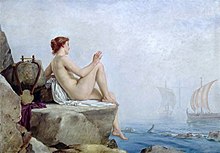
Armitage Siren.JPG
The Sirens were dangerous yet beautiful creatures, who lured nearby sailors with their enchanting music and voices to shipwreck on the rocky coast of their island.
The siren song is a promise to Odysseus of mantic truths; with a false promise that he will live to tell them, they sing,
Once he hears to his heart's content, sails on, a wiser man.
We know all the pains that the Greeks and Trojans once endured
on the spreading plain of Troy when the gods willed it so—
all that comes to pass on the fertile earth, we know it all!

Ithaca
View of Vathy
Ithaca has been identified as the home of the mythological hero Odysseus. In the Odyssey of Homer, Ithaca is described thus
" dwell in shining Ithaca. There is a mountain there,
high Neriton, covered in forests. Many islands
lie around it, very close to each other,
Doulichion, Same, and wooded Zacynthos–
but low-lying Ithaca is farthest out to sea,
towards the sunset, and the others are apart, towards the dawn and sun.
It is rough, but it raises good men."


Cassandra
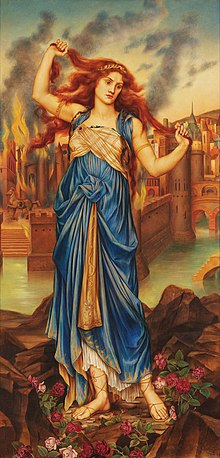
Cassandra, also known as Alexandra or Kassandra, was the daughter of King Priam and Queen Hecuba of Troy.

A common version of her story is that Apollo gave her the power of prophecy in order to seduce her, but when she refused, he spat into her mouth cursing her never to be believed. Cassandra is a figure of epic tradition and of tragedy.


Agamemnon
Agamemnon was the son of King Atreus and Queen Aerope of Mycenae, the brother of Menelaus, the husband of Clytemnestra and the father of Iphigenia, Electra or Laodike, Orestes and Chrysothemis. Mythical legends make him the king of Mycenae or Argos, thought to be different names for the same area. When Helen, the wife of Menelaus, ran off with Paris of Troy, Agamemnon commanded the united Greek armed forces in the ensuing Trojan War.

Upon Agamemnon's return from Troy, he was murdered  by Aegisthus, the lover of his wife, Clytemnestra.

Vocabulary and word
Meph/f/istoph/f/eles(Devil)
Nymph(Nymphomaniac)

2015年10月14日 星期三

Western Literature Week 5

Hermes
Hermes Ingenui Pio-Clementino Inv544.jpg
Hermes is considered a god of transitions and boundaries. He is described as quick and cunning, moving freely between the worlds of the mortal and divine. He is also portrayed as an emissary and messenger of the gods: an intercessor between mortals and the divine, and conductor of souls into the afterlife. He has been viewed as the protector and patron of herdsmen, thieves, oratory and wit, literature and poetry, athletics and sports, invention and trade, roads, boundaries and travelers.

Iris
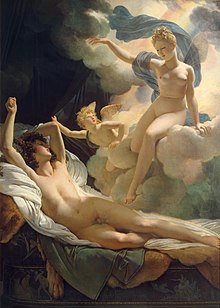
Guerin Pierre Narcisse - Morpheus and Iris 1811.jpg

Iris is the personification of the rainbow and messenger of the gods. She is also known as one of the goddesses of the sea and the sky. Iris links the gods to humanity. She travels with the speed of wind from one end of the world to the other, and into the depths of the sea and the underworld.

Eris
Eris Antikensammlung Berlin F1775.jpg
Eris is the Greek goddess of chaos, strife, and discord. Her name is the equivalent of Latin Discordia, which means "discord". Homer equated her with the war-goddess Enyo, whose Roman counterpart is Bellona. The dwarf planet Eris is named after the goddess, as is the religion Discordianism.


Vocabulary and word
Para-: Side by side/having the same distance between them
paradoxical
paragraph
parachute
parallel
parasol
paradox

Dic-: To say, to tell word
predict
dictator

Ab-: Negative root
abduction
abduc(kidnap)

Nero, Hero, Zero→/i/

Vir = Ver →Virture = Verture
Veritas: meaning truth, was the goddess of truth. It was believed that she hid in the bottom of a holy well because she was so elusive.Her image is shown as a young virgin dressed in white.
Flert: Trying to attract someone
Night raid: Attack
Warrior: soldier, fighter
Champion: The leader of fighter
Final Destination→Destiny
Final destination 09.jpg
Fatal→Fate

2015年10月7日 星期三

Western Literature Week 4

Epic poetry

An epic poem, epic is a lengthy narrative poem, ordinarily concerning a serious subject containing details of heroic deeds and events significant to a culture or nation. Milman Parry and Albert Lord have argued that the Homeric epics, the earliest works of Western literature, were fundamentally an oral poetic form. These works form the basis of the epic genre in Western literature. Nearly all Western epic self-consciously presents itself as a continuation of the tradition begun by these poems. Classical epic employs dactylic hexameter and recounts a journey, either physical (as typified by Odysseus in the Odyssey) or mental (as typified by Achilles in the Iliad) or both. Epics also tend to highlight cultural norms and to define or call into question cultural values, particularly as they pertain to heroism.
Another type of epic poetry is epyllion, which is a brief narrative poem with a romantic or mythological theme. The term, which means "little epic", came into use in the nineteenth century. It refers primarily to the erudite, shorter hexameter poems of the Hellenistic period and the similar works composed at Rome from the age of the neoterics; to a lesser degree, the term includes some poems of the English Renaissance, particularly those influenced by Ovid. The most famous example of classical epyllion is perhaps Catullus 64.

The Iliad
The Iliad in Classical Attic; sometimes referred to as the Song of Ilion or Song of Ilium, is an ancient Greek epic poem in dactylic hexameter, traditionally attributed to Homer. Set during the Trojan War, the ten-year siege of the city of Troy by a coalition of Greek states, it tells of the battles and events during the weeks of a quarrel between King Agamemnon and the warrior Achilles.

Although the story covers only a few weeks in the final year of the war, the Iliad mentions or alludes to many of the Greek legends about the siege; the earlier events, such as the gathering of warriors for the siege, the cause of the war, and related concerns tend to appear near the beginning. Then the epic narrative takes up events prophesied for the future, such as Achilles' looming death and the sack of Troy, prefigured and alluded to more and more vividly, so that when it reaches an end, the poem has told a more or less complete tale of the Trojan War.

The Iliad is paired with something of a sequel, the Odyssey, also attributed to Homer. Along with the Odyssey, the Iliad is among the oldest extant works of Western literature, and its written version is usually dated to around the eighth century BC. Recent statistical modelling based on language evolution gives a date of 760–710 BC. It is written in Homeric Greek, a literary amalgam of Ionic Greek and other dialects.
Achilles Lamenting the Death of Patroclus

Achilles Slays Hector

The Trojan War
The Trojan War was waged against the city of Troy by the Achaeans (Greeks) after Paris of Troy took Helen from her husband Menelaus, king of Sparta. The war is one of the most important events in Greek mythology and has been narrated through many works of Greek literature, most notably through Homer's Iliad. The Iliad relates a part of the last year of the siege of Troy; the Odyssey describes the journey home of Odysseus, one of the war's heroes. Other parts of the war are described in a cycle of epic poems, which have survived through fragments. Episodes from the war provided material for Greek tragedy and other works of Greek literature, and for Roman poets including Virgil and Ovid.

Odysseus
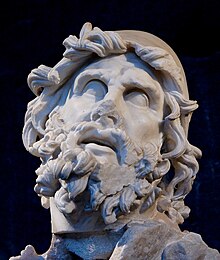
Head Odysseus MAR Sperlonga.jpg
Odysseus was a legendary Greek king of Ithaca and the hero of Homer's epic poem the Odyssey. Odysseus also plays a key role in Homer's Iliad and other works in that same epic cycle.
Husband of Penelope, father of Telemachus, and son of Laërtes and Anticlea, Odysseus is renowned for his brilliance, guile, and versatility (polytropos), and is hence known by the epithet Odysseus the Cunning (cunning intelligence). He is most famous for the ten eventful years he took to return home after the decade-long Trojan War.

Xanthus
Xanthus also known as Scamander, is the river god.
Scamander fought on the side of the Trojans during the Trojan War, after the Greek hero Achilles insulted him. Scamander was also said to have attempted to kill Achilles three times, and the hero was only saved due to the intervention of Hera, Athena and Hephaestus. In this context, he is the personification of the Scamander River that flowed from Mount Ida across the plain beneath the city of Troy, joining the Hellespont north of the city. The Achaeans, according to Homer, had set up their camp near its mouth, and their battles with the Trojans were fought on the plain of Scamander. Homer states that the river had two springs: one produced warm water; the other yielded cold water, regardless of the season.

The Great Gatsby
  • I am still a little afraid of missing something if I forget that, as my father snobbishly suggested, and I snobbishly repeat a sense of the fundamental decencies is parcelled out unequally at birth.
  • If personality is an unbroken series of successful gestures, then there was something gorgeous about him, some heightened sensitivity to the promises of life, as if he were related to one of those intricate machines that register earthquakes ten thousand miles away.


A History of the Months
January -- Janus's month
February -- month of Februa
March -- Mars' month
April -- Aphrodite's month
May -- Maia's month
June -- Juno's month
July -- Julius Caesar's month
August -- Augustus Caesar's month
September -- the seventh month
October -- the eighth month
November -- the ninth month
December -- the tenth month