2015年12月30日 星期三

Western Literature Week 16

WASP: Whit Anglo-Saxon Protestant or a boat in Sturat Little


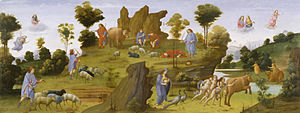
Sodom and Gomorrah 

Sodom and Gomorrah were cities mentioned in the Book of Genesis and throughout the Hebrew Bible, the New Testament and in the deuterocanonical Book of Wisdom, as well as in the Qur'an and hadith.
According to the Torah, the kingdoms of Sodom and Gomorrah were allied with the cities of Admah, Zeboim and Bela.

Orpheus and Eurydice
「Orpheus and Eurydice」的圖片搜尋結果
Charon: In Greek mythology, Charon or Kharon is the ferryman of Hades who carries souls of the newly deceased across the rivers Styx and Acheron that divided the world of the living from the world of the dead. 
Back from the Underworld: Orpheus, Aeneas, Odysses, PsycheOrpheus goes to find his wife.Aeneas goes to pay a duty call on his dead father Anchises.Odysseus goes to the Underworld for help getting home.Psyche goes to complete the task from Aphrodite.


The Fall
In Christian theology, the fall of man, or the fall, is a term used to describe the transition of the first man and woman from a state of innocent obedience to God to a state of guilty disobedience. Although not named in the Bible, the doctrine of the fall comes from a biblical interpretation of Genesis chapter 3. At first, Adam and Eve lived with God in the Garden of Eden, but the serpent tempted them into eating the fruit from the tree of knowledge of good and evil, which God had forbidden. After doing so, they became ashamed of their nakedness and God expelled them from the Garden to prevent them from eating from the tree of life and becoming immortal.  For many Christian denominations the doctrine of the fall is closely related to that of original sin. They believe that the fall brought sin into the world, corrupting the entire natural world, including human nature, causing all humans to be born into original sin, a state from which they cannot attain eternal life without the grace of God.

Prometheus and Pandora
「pandora greek」的圖片搜尋結果
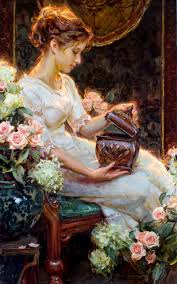
Henceforth, humans would keep that meat for themselves and burn the bones wrapped in fat as an offering to the gods. This angered Zeus, who hid fire from humans in retribution. In this version of the myth, the use of fire was already known to humans, but withdrawn by Zeus.Prometheus, however, stole fire back in a giant fennel-stalk and restored it to humanity. This further enraged Zeus, who sent Pandora, the first woman, to live with humanity. Pandora was fashioned by Hephaestus out of clay and brought to life by the four winds, with all the goddesses of Olympus assembled to adorn her. "From her is the race of women and female kind," Hesiod writes; "of her is the deadly race and tribe of women who live amongst mortal men to their great trouble, no helpmeets in hateful poverty, but only in wealth."

Tower of Babel
「Tower of Babel」的圖片搜尋結果
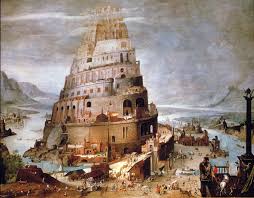
The Tower of Babel is an etiological myth in the Book of Genesis of the Tanakh (also referred to as the Hebrew Bible or the Old Testament) meant to explain the origin of different languages. According to the story, a united humanity of the generations following the Great Flood, speaking a single language and migrating from the east, came to the land of Shinar. There they agreed to build a city and tower; seeing this, God confounded their speech so that they could no longer understand each other and scattered them around the world.

Vocabulary and word
Fra: to smash to pieces, to shatter
  • fragile(a.): easily broken or damaged; very delicate; not strong
  • fragment(n.): a broken part of something; an incomplete part
  • frail(a.): having less than a normal amount of strength or force; very weak; easily damaged or destroyed
  • frailty(n.): physical weakness; the quailty or state of being frail; weakness of character that causes a person to do things thats are morally wrong
Mor: death, dead
  • immortal(a.): not capapble of dying; living forever
  • immortality(n.): the quality or state of someone or something that will never die or be forgotten; the quality or state of being immortal
  • morgue(n.): a place where the bodies of dead people are kept until they are buried or cremated
  • mortician(n.): a person whose job is to prepare dead people to be buried and to arrange and manage funerals
  • mortify(v.): to cause(someone) to feel very embarrassed and foolish
Raven:Omen
scarecrow
strawhatdrinking straw
2015年12月23日 星期三

Western Literature Week 15

Bible
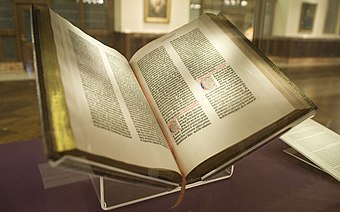
The Bible is a collection of texts sacred in Judaism and Christianity. It is a collection of scriptures written at different times by different authors in different locations. Jews and Christians consider the books of the Bible to be a product of divine inspiration or an authoritative record of the relationship between God and humans.With estimated total sales of over 5 billion copies, the Bible is widely considered to be the best selling book of all time.


The Old Testament
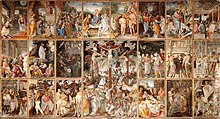
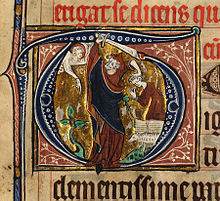
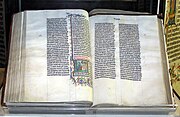
The Malmesbury Bible
The Old Testament consists of many distinct books written, compiled, and edited by various authors over a period of centuries. It is not entirely clear at what point the parameters of the Hebrew Bible, the basis for the Christian Old Testament, were fixed.
The books of the Old Testament can be broadly divided into several sections:
  1. The first five books or Pentateuch (Torah)
  2. The history books telling the history of the Israelites, from their conquest of Canaan to their defeat and exile in Babylon
  3. The poetic and "Wisdom" books dealing, in various forms, with questions of good and evil in the world
  4. And the books of the biblical prophets, warning of the consequences of turning away from God.


The New Testament
The New Testament is the second major part of the Christian biblical canon, the first part being the Old Testament, based on the Hebrew Bible.
The New Testament is a collection of 27 books of 4 different genres of Christian literature (Gospels, one account of the Acts of the Apostles, Epistles and an Apocalypse). Jesus is its central figure. The mainstream consensus is that the New Testament was written in a form of Koine Greek.

  • Gospel of Luke

It tells of the origins, birth, ministry, death, resurrection and ascension of Jesus Christ.
  • Gospel of Matthew

It is one of the four canonical gospels, one of the three synoptic gospels, and the first book of the New Testament. The narrative tells how the Messiah, Jesus, rejected by Israel, finally sends the disciples to preach his Gospel to the whole world.

Genesis 1:4
Genesis 1:4 is the fourth verse of the first chapter in the Genesis. It is the response to God's command in verse 3, "Let there be light." It is part of the Genesis creation narrative within the Torah portion Bereshit. (Genesis 1:1–6:8) The verse states that the light was good, and that God divided or separated the light from the darkness.

Abraham and Isaac
Abraham was commanded by God to offer his son up as a sacrifice in the land of Moriah. The patriarch traveled three days until he came to the mount that God told him of. He commanded the servants to remain while he and Isaac proceeded alone into the mount. Isaac carried the wood upon which he would be sacrificed. Along the way, Isaac asked his father where the animal for the burnt offering was, to which Abraham replied "God will provide himself a lamb for a burnt offering". Just as Abraham was about to sacrifice his son, he was interrupted by "the angel of the LORD", and he saw behind him a "ram caught in a thicket by his horns", which he sacrificed instead of his son. For his obedience he received another promise of numerous descendants and abundant prosperity.

Jane Eyre
“I sometimes have a queer feeling with regard to you - especially when you are near me, as now: it is as if I had a string somewhere under my left ribs, tightly and inextricably knotted to a similar string situated in the corresponding quarter of your little frame. And if that boisterous channel, and two hundred miles or so of land some broad between us, I am afraid that cord of communion will be snapt; and then I've a nervous notion I should take to bleeding inwardly. As for you, - you'd forget me.”
― Charlotte Brontë, Jane Eyre

No Strings Attached

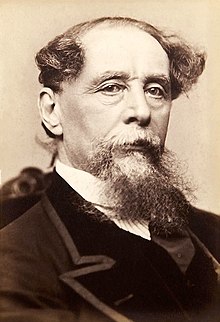
Charles Dickens
Charles Dickens
Charles John Huffam Dickens was an English writer and social critic. He created some of the world's best-known fictional characters and is regarded as the greatest novelist of the Victorian era. His works enjoyed unprecedented popularity during his lifetime, and by the twentieth century critics and scholars had recognized him as a literary genius. His novels and short stories enjoy lasting popularity.
  • A Christmas Carol

A Christmas Carol tells the story of a bitter old miser named Ebenezer Scrooge and his transformation into a gentler, kindlier man after visitations by the ghost of his former business partner Jacob Marley and the Ghosts of Christmas Past, Present and Yet to Come.
Scrooge
The name "Scrooge" is used in English as a word for a person who is misanthropic and tight-fisted despite the fact Ebenezer Scrooge reformed later.

  • David Copperfield

「David Copperfield book」的圖片搜尋結果
Many elements of the novel follow events in Dickens' own life, and it is probably the most autobiographical of his novels. He wrote "Like many fond parents, I have in my heart of hearts a favourite child. And his name is David Copperfield."


Vocabulary and word
Gay: About 50 years ago means “Extremely happy”.
Fresco: a painting done rapidly in watercolor on wet plaster on a wall or ceiling, so that the colors penetrate the plaster and become fixed as it dries.

2015年12月16日 星期三

Western Literature Week 14


Aristotle
Aristotle Altemps Inv8575.jpg
Aristotle was a Greek philosopher and scientist. His writings cover many subjects – including physics, biology, zoology, metaphysics, logic, ethics, aesthetics, poetry, theater, music, rhetoric, linguistics, politics and government – and constitute the first comprehensive system of Western philosophy. According to the Encyclopædia Britannica, "Aristotle was the first genuine scientist in history ... every scientist is in his debt."
Teaching Alexander the Great gave Aristotle many opportunities and an abundance of supplies. He established a library in the Lyceum which aided in the production of many of his hundreds of books. The fact that Aristotle was a pupil of Plato contributed to his former views of Platonism, but, following Plato's death, Aristotle immersed himself in empirical studies and shifted from Platonism to empiricism. He believed all peoples' concepts and all of their knowledge was ultimately based on perception.

Poetics
Aristotle's Poetics is the earliest surviving work of dramatic theory and the first extant philosophical treatise to focus on literary theory.In it, Aristotle offers an account of what he calls "poetry" (a term which in Greek literally means "making" and in this context includes drama—comedy, tragedy, and the satyr play—as well as lyric poetry and epic poetry). They are similar in the fact that they are all imitations but different in the three ways that Aristotle describes:
1.   Differences in music rhythm, harmony, meter and melody.
2.   Difference of goodness in the characters.
3.   Difference in how the narrative is presented: telling a story or acting it out.


Three unities→
  • Unity of action
  • Unity of place
  • Unity of time

Tragic flaw→ Hamartia
Tragic hero→
  • Must be Good
  • Must be Consistent
  • Must be of high social status


Vocabulary and word
Self abuse: Masturbation
Abstinence: The fact or practice of restraining oneself from indulging in something
Farce: A comic dramatic work using buffoonery and horseplay and typically including crude characterization and ludicrously improbable situations.
Mimesis: Imitation, Representation, Mimicry
POV: Point of view

2015年12月9日 星期三

Western Literature Week 13

Aristophanes
Aristophanes - Project Gutenberg eText 12788.png
Aristophanes was a comic playwright of ancient Athens. Eleven of his thirty plays survive virtually complete. These, together with fragments of some of his other plays, provide the only real examples of a genre of comic drama known as Old Comedy, and they are used to define the genre.

Also known as the Father of Comedy and the Prince of Ancient Comedy, Aristophanes has been said to recreate the life of ancient Athens more convincingly than any other author. His powers of ridicule were feared and acknowledged by influential contemporaries; Plato singled out Aristophanes' play The Clouds as slander that contributed to the trial and subsequent condemning to death of Socrates although other satirical playwrights had also caricatured the philosopher.

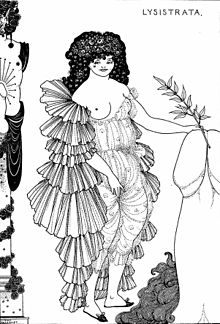
Lysistrata
Lysistrata.jpg
Lysistrata is a comedy by Aristophanes. Originally performed in classical Athens in 411 BC, it is a comic account of one woman's extraordinary mission to end the Peloponnesian War. Lysistrata persuades the women of Greece to withhold sexual privileges from their husbands and lovers as a means of forcing the men to negotiate peace—a strategy, however, that inflames the battle between the sexes. The play is notable for being an early expose of sexual relations in a male-dominated society(citation needed). Additionally, its dramatic structure represents a shift from the conventions of Old Comedy, a trend typical of the author's career. It was produced in the same year as the Thesmophoriazusae, another play with a focus on gender-based issues, just two years after Athens' catastrophic defeat in the Sicilian Expedition.

Hubris: Pride/Arrogance
Faust
Chorus: Ideal spectator/Audience
Purple robes
Blue blood: Noble birth

2015年12月2日 星期三

Western Literature Week 12

Dionysia

The Dionysia was a large festival in ancient Athens in honor of the god Dionysus, the central events of which were the theatrical performances of dramatic tragedies and, from 487 BC, comedies. It was the second-most important festival after the Panathenaia. The Dionysia actually consisted of two related festivals, the Rural Dionysia and the City Dionysia, which took place in different parts of the year.
Theatre = Theater

Deus ex machine
Deus ex machina is a Latin calque meaning "god from the machine". The term has evolved to mean a plot device whereby a seemingly unsolvable problem is suddenly and abruptly resolved by the contrived and unexpected intervention of some new event, character, ability or object. Depending on how it is done, it can be intended to move the story forward when the writer has "painted himself into a corner" and sees no other way out, to surprise the audience, to bring the tale to a happy ending, or as a comedic device.
The term was coined from the conventions of Greek tragedy, where a machine is used to bring actors playing gods onto the stage. The machine could be either a crane (mechane) used to lower actors from above or a riser that brought actors up through a trapdoor. Preparation to pick up the actors was done behind the skene. The idea was introduced by Aeschylus and was used often to resolve the conflict and conclude the drama. Although the device is associated mostly with Greek tragedy, it also appeared in comedies.

Medea
Medea is a sorceress who was the daughter of King Aeëtes of Colchis, niece of Circe, granddaughter of the sun god Helios, and later wife to the hero Jason, with whom she had two children, Mermeros and Pheres. In Euripides's play Medea, Jason leaves Medea when Creon, king of Corinth, offers him his daughter, Glauce. The play tells of Medea avenging her husband's betrayal by killing their children.

The myths involving Jason have been interpreted as part of a class of myths that tell how the Hellenes of the distant heroic age, before the Trojan War, faced the challenges of the pre-Greek "Pelasgian" cultures of mainland Greece, the Aegean and Anatolia. Jason, Perseus, Theseus, and above all Heracles, are all "liminal" figures, poised on the threshold between the old world of shamans, chthonic earth deities, and the new Bronze Age Greek ways.

Medea figures in the myth of Jason and the Argonauts, a myth known best from a late literary version worked up by Apollonius of Rhodes in the 3rd century BC and called the Argonautica. However, for all its self-consciousness and researched archaic vocabulary, the late epic was based on very old, scattered materials. Medea is known in most stories as an enchantress and is often depicted as being a priestess of the goddess Hecate or a witch. It was known to the composer of the Little Iliad, part of the Epic Cycle.
Domestic wrangling: Both moral and psychological.

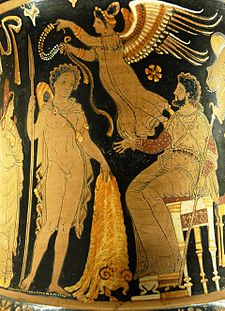
Jason
Jason was an ancient Greek mythological hero who was famous for his role as the leader of the Argonauts and their quest for the Golden Fleece. He was the son of Aeson, the rightful king of Iolcos. He was married to the sorceress Medea.

The Golden Fleece
the Golden Fleece is the fleece of the gold-hair winged ram, which was held in Colchis. The fleece is a symbol of authority and kingship. It figures in the tale of the hero Jason and his band of Argonauts, who set out on a quest for the fleece by order of King Pelias, in order to place Jason rightfully on the throne of Iolcus in Thessaly. Through the help of Medea, they acquire the Golden Fleece.

Fidelity: Faithfulness to a person, cause, or belief, demonstrated by continuing loyalty and support.
Robe: A long, loose outer garment.

2015年11月25日 星期三

Western Literature Week 11

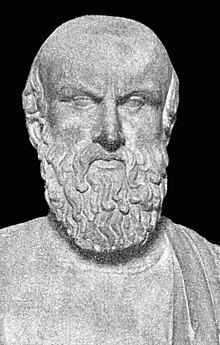
Aeschylus
Aischylos Büste.jpg
Aeschylus was an ancient Greek tragedian. He is also the first whose plays still survive; the others are Sophocles and Euripides. He is often described as the father of tragedy: critics and scholars' knowledge of the genre begins with his work, and understanding of earlier tragedies is largely based on inferences from his surviving plays. According to Aristotle, he expanded the number of characters in theater to allow conflict among them, whereas characters previously had interacted only with the chorus.

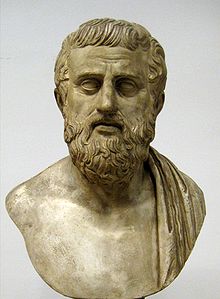
Sophocles
Sophocles pushkin.jpg
Sophocles is one of three ancient Greek tragedians whose plays have survived. His first plays were written later than those of Aeschylus, and earlier than or contemporary with those of Euripides. Sophocles wrote 120 plays during the course of his life, but only 7 have survived in a complete form: Ajax, Antigone, The Women of Trachis, Oedipus the King, Electra, Philoctetes and Oedipus at Colonus. For almost 50 years, Sophocles was the most-fêted playwright in the dramatic competitions of the city-state of Athens that took place during the religious festivals of the Lenaea and the Dionysia. He competed in 30 competitions, won 18, and was never judged lower than second place. Aeschylus won 14 competitions, and was sometimes defeated by Sophocles, while Euripides won 5 competitions.
The most famous tragedies of Sophocles feature Oedipus and also Antigone: they are generally known as the Theban plays, although each play was actually a part of a different tetralogy, the other members of which are now lost. Sophocles influenced the development of the drama, most importantly by adding a third actor, thereby reducing the importance of the chorus in the presentation of the plot. He also developed his characters to a greater extent than earlier playwrights such as Aeschylus
Euripides
Euripides Pio-Clementino Inv302.jpg
Euripides was a tragedian of classical Athens. He is one of the few whose plays have survived, with the others being Aeschylus, Sophocles, and potentially Euphorion.
Euripides is identified with theatrical innovations that have profoundly influenced drama down to modern times, especially in the representation of traditional, mythical heroes as ordinary people in extraordinary circumstances. This new approach led him to pioneer developments that later writers adapted to comedy, some of which are characteristic of romance. Yet he also became "the most tragic of poets", focusing on the inner lives and motives of his characters in a way previously unknown.
He was also unique among the writers of ancient Athens for the sympathy he demonstrated towards all victims of society, including women. His conservative male audiences were frequently shocked by the 'heresies' he put into the mouths of characters, such as these words of his heroine Medea:
Sooner would I stand
Three times to face their battles, shield in hand,
Than bear one child!
His contemporaries associated him with Socrates as a leader of a decadent intellectualism, both of them being frequently lampooned by comic poets such as Aristophanes. Whereas Socrates was eventually put on trial and executed as a corrupting influence, Euripides chose a voluntary exile in old age, dying in Macedonia.


Tragedy: Catharsis
drama(classical Greek drama): narrative, fictional, in performance: tragedy, comedy, satyr play
eg for satyr play: mortal mother(emmele: Dionysus's mother); patroness 主保神of Athens: Athena
innovation; rennovation
be credited with
Peloponnesian War
vok, voc: to call
provoke
invoke
Ancient Athenian Drama
the nature of justice
the meaning of suffering
clashes between family and state and between human and divine perspective
inauguration
Dionysus(Greek name)
Bacchus(Roman name)
The Great Gastby(In the Begining Paragraph 1)
snob
there was something gorgeous about him
vulnerable
temperament
cocky→Oedipus(king of Thepis)
plague
Kreon(Creon)
footnote

逆著性子做事,順著天意

2015年11月18日 星期三

Western Literature Week 10

Lost Civilization (video from min.7 10 33 46)

We must learn to read (Youtube  Movie2)

Detachment (Separation)
Detachment poster.jpg

It's Greek to me.
That's Greek to me or It's (all) Greek to me is an idiom in English, expressing that something is not understandable.

Youth is a statue of mind, not a time of life.

Apollo→Knowledge, light and music 
wine→theatre
5-day festival
Dithyramb
Tragedy/Comedy
Play: medea
Delph:
Prophet
Phet: knowledge, light, poetry reading
Oracle: pythian

Poem: Lord Alfred Tennyson's "Ulysses"
… Come, my friends,
     'Tis not too late to seek a newer world.
     Push off, and sitting well in order smite
     The sounding furrows; for my purpose holds
     To sail beyond the sunset, and the baths
     Of all the western stars, until I die.
     It may be that the gulfs will wash us down;
     It may be we shall touch the Happy Isles,
     And see the great Achilles, whom we knew.

2015年11月4日 星期三

Western Literature Week 8

My Fair Lady

Fair
  • Beautiful, attractive.
  • In accordance with the rules or standards, legitimate.


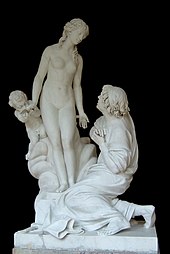
Pygmalion
Pygmalion is a legendary figure of Cyprus. Though Pygmalion is the Greek version of the Phoenician royal name Pumayyaton, he is most familiar from Ovid's narrative poem Metamorphoses, in which Pygmalion was a sculptor who fell in love with a statue he had carved.
The Pygmalion effect: Pygmalion effect or Rosenthal effect, is the phenomenon whereby higher expectations lead to an increase in performance.

Duty: Responsibility/Obligation
Duty free

2015年10月28日 星期三

Western Literature Week 7

Myth
The ancient Roman poet Ovid, in his "The Metamorphoses," told the story of the nymph Io who was seduced by Jupiter, the king of the gods. When his wife Juno became jealous, Jupiter transformed Io into a heifer to protect her. This panel relates the second half of the story. In the upper left, Jupiter emerges from clouds to order Mercury to rescue Io. In the lower left, Mercury guides his herd to the spot where Io is guarded by the hundred-eyed Argus. In the upper center, Mercury, disguised as a shepherd, lulls Argus to sleep and beheads him. Juno then takes Argus's eyes to ornament the tail feathers of her peacock and sends the Furies to pursue Io, who flees to the Nile River. At last, Jupiter prevails on his wife to cease tormenting the nymph, who, upon resuming her natural form, escapes to the forest and ultimately becomes the Egyptian goddess Isis
A myth is any worldview-based traditional story, collection or study. It is derived from the Greek word mythos, which simply means "story". Mythology can refer either to the study of myths, or to a body or collection of myths.

X/z/enia
X/z/erox copy (carbon dioxide→C.C.)

Q-lip
Cotton swabs (American) or cotton buds (British) consist of a small wad of cotton wrapped around one or both ends of a short rod, usually made of either wood, rolled paper, or plastic. They are commonly used in a variety of applications including first aid, cosmetics application, cleaning, and arts and crafts.

Tampon
A tampon is a mass of absorbent material, primarily used as a feminine hygiene product. Historically, the word "tampon" originated from the medieval French word "tampion", meaning a piece of cloth to stop a hole, a stamp, plug, or stopper. At present, tampons are designed to be easily inserted into the vagina during menstruation and absorb the menstrual flow.

Kotex
「Kotex」的圖片搜尋結果
Kotex is a brand of feminine hygiene products, which includes the Kotex maxi, thin and ultra thin pads, the Security tampons, and the Lightdays pantiliners.

Rage: Outrageous/Fury/Angry
A bird of prey→Prey, Predator
Elegy: A short liris poem that related to
Eulogy(eu: good)