Dionysia

The
Dionysia was a large festival in ancient Athens in honor of the god Dionysus,
the central events of which were the theatrical performances of dramatic
tragedies and, from 487 BC, comedies. It was the second-most important festival
after the Panathenaia. The Dionysia actually consisted of two related
festivals, the Rural Dionysia and the City Dionysia, which took place in
different parts of the year.
Theatre = Theater
Deus
ex machine

Deus ex machina is a
Latin calque meaning "god from the machine". The term has evolved to
mean a plot device whereby a seemingly unsolvable problem is suddenly and
abruptly resolved by the contrived and unexpected intervention of some new
event, character, ability or object. Depending on how it is done, it can be
intended to move the story forward when the writer has "painted himself
into a corner" and sees no other way out, to surprise the audience, to
bring the tale to a happy ending, or as a comedic device.
The
term was coined from the conventions of Greek tragedy, where a machine is used
to bring actors playing gods onto the stage. The machine could be either a
crane (mechane) used to lower actors from above or a riser that brought actors
up through a trapdoor. Preparation to pick up the actors was done behind the
skene. The idea was introduced by Aeschylus and was used often to resolve the
conflict and conclude the drama. Although the device is associated mostly with
Greek tragedy, it also appeared in comedies.
Medea

Medea
is a sorceress who was the daughter of King Aeëtes of Colchis, niece of Circe,
granddaughter of the sun god Helios, and later wife to the hero Jason, with
whom she had two children, Mermeros and Pheres. In Euripides's play Medea,
Jason leaves Medea when Creon, king of Corinth, offers him his daughter,
Glauce. The play tells of Medea avenging her husband's betrayal by killing
their children.
The
myths involving Jason have been interpreted as part of a class of myths that
tell how the Hellenes of the distant heroic age, before the Trojan War, faced
the challenges of the pre-Greek "Pelasgian" cultures of mainland
Greece, the Aegean and Anatolia. Jason, Perseus, Theseus, and above all Heracles,
are all "liminal" figures, poised on the threshold between the old
world of shamans, chthonic earth deities, and the new Bronze Age Greek ways.
Medea
figures in the myth of Jason and the Argonauts, a myth known best from a late
literary version worked up by Apollonius of Rhodes in the 3rd century BC and
called the Argonautica. However, for all its self-consciousness and researched
archaic vocabulary, the late epic was based on very old, scattered materials.
Medea is known in most stories as an enchantress and is often depicted as being
a priestess of the goddess Hecate or a witch. It was known to the composer of
the Little Iliad, part of the Epic Cycle.
Domestic wrangling: Both moral and psychological.
Jason

Jason
was an ancient Greek mythological hero who was famous for his role as the
leader of the Argonauts and their quest for the Golden Fleece. He was the son
of Aeson, the rightful king of Iolcos. He was married to the sorceress Medea.
The Golden
Fleece
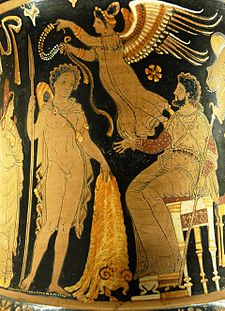
the
Golden Fleece is the fleece of the gold-hair winged ram, which was held in
Colchis. The fleece is a symbol of authority and kingship. It figures in the
tale of the hero Jason and his band of Argonauts, who set out on a quest for
the fleece by order of King Pelias, in order to place Jason rightfully on the
throne of Iolcus in Thessaly. Through the help of Medea, they acquire the
Golden Fleece.
Fidelity: Faithfulness
to a person, cause, or belief, demonstrated by continuing loyalty and support.
Robe: A long, loose outer garment.


沒有留言:
張貼留言