Marguerite Duras

Duras, 1993
Marguerite Donnadieu, known as Marguerite
Duras ( 4 April 1914 – 3 March 1996), was a French novelist, playwright,
scriptwriter, essayist and experimental filmmaker. She is best known for
writing the 1959 film Hiroshima mon amour, which earned her a nomination for
Best Original Screenplay at the Academy Awards.
Hiroshima mon amour

Hiroshima mon amour (French pronunciation: [iʁoʃima mɔ̃.n‿amuʁ], Hiroshima My Love; Japanese: 二十四時間の情事 Nijūyojikan'nojōji, Twenty-four-hour affair) is a 1959 drama film
directed by French film director Alain Resnais, with a screenplay by Marguerite
Duras. It is the documentation of an intensely personal conversation between a
French-Japanese couple about memory and forgetfulness. It was a major catalyst
for the Left Bank Cinema, making highly innovative use of miniature flashbacks
to create a uniquely nonlinear storyline.
Song Sharing: 我多麼羨慕你
Walt Whitman

Walter
"Walt" Whitman (/ˈhwɪtmən/; May 31,
1819 – March 26, 1892) was an American poet, essayist, and journalist. A
humanist, he was a part of the transition between transcendentalism and
realism, incorporating both views in his works. Whitman is among the most
influential poets in the American canon, often called the father of free verse.
His work was very controversial in its time, particularly his poetry collection
Leaves of Grass, which was described as obscene for its overt sexuality.
Born in Huntington on Long Island, Whitman
worked as a journalist, a teacher, a government clerk, and—in addition to
publishing his poetry—was a volunteer nurse during the American Civil War.
Early in his career, he also produced a temperance novel, Franklin Evans
(1842). Whitman's major work, Leaves of Grass, was first published in 1855 with
his own money. The work was an attempt at reaching out to the common person
with an American epic. He continued expanding and revising it until his death
in 1892. After a stroke towards the end of his life, he moved to Camden, New
Jersey, where his health further declined. When he died at age 72, his funeral
became a public spectacle.
"Song of Myself"
Song of Myself" is a poem by Walt
Whitman that is included in his work Leaves of Grass. It has been credited as
"representing the core of Whitman’s poetic vision." The poem is written
in Whitman's signature free verse style. Whitman, who praises words "as
simple as grass" (section 39) forgoes standard verse and stanza patterns
in favor of a simple, legible style that can appeal to a mass audience.
I celebrate myself, and sing myself,
And what I assume you shall assume,
For every atom belonging to me as good
belongs to you.
I loafe and invite my soul,
I lean and loafe at my ease observing a
spear of summer grass.
My tongue, every atom of my blood, form'd
from this soil, this air,
Born here of parents born here from parents
the same, and their parents the same,
I, now thirty-seven years old in perfect
health begin,
Hoping to cease not till death.
Creeds and schools in abeyance,
Retiring back a while sufficed at what they
are, but never forgotten,
I harbor for good or bad, I permit to speak
at every hazard,
Nature without check with original energy.
Emily Dickinson

Emily Elizabeth Dickinson (December 10,
1830 – May 15, 1886) was an American poet. Dickinson was born in Amherst,
Massachusetts. Although part of a prominent family with strong ties to its
community, Dickinson lived much of her life highly introverted. After studying
at the Amherst Academy for seven years in her youth, she briefly attended the
Mount Holyoke Female Seminary before returning to her family's house in
Amherst. Considered an eccentric by locals, she developed a noted penchant for
white clothing and became known for her reluctance to greet guests or, later in
life, to even leave her bedroom. Dickinson never married, and most friendships
between her and others depended entirely upon correspondence.
While Dickinson was a prolific private
poet, fewer than a dozen of her nearly 1,800 poems were published during her
lifetime.The work that was published during her lifetime was usually altered
significantly by the publishers to fit the conventional poetic rules of the
time. Dickinson's poems are unique for the era in which she wrote; they contain
short lines, typically lack titles, and often use slant rhyme as well as
unconventional capitalization and punctuation. Many of her poems deal with
themes of death and immortality, two recurring topics in letters to her
friends.
"A narrow Fellow in the Grass"
A narrow fellow in the grass
Occasionally rides;
You may have met him—did you not
His notice instant is,
The grass divides as with a comb,
A spotted shaft is seen,
And then it closes at your feet,
And opens further on.
He likes a boggy acre
A floor too cool for corn,
Yet when a boy and barefoot,
I more than once at noon
Have passed, I thought, a whip lash,
Unbraiding in the sun,
When stooping to secure it,
It wrinkled and was gone.
Several of nature's people
I know, and they know me;
I feel for them a transport
Of cordiality.
Yet never met this fellow,
Attended or alone,
Without a tighter breathing,
And zero at the bone.
Samuel Taylor Coleridge
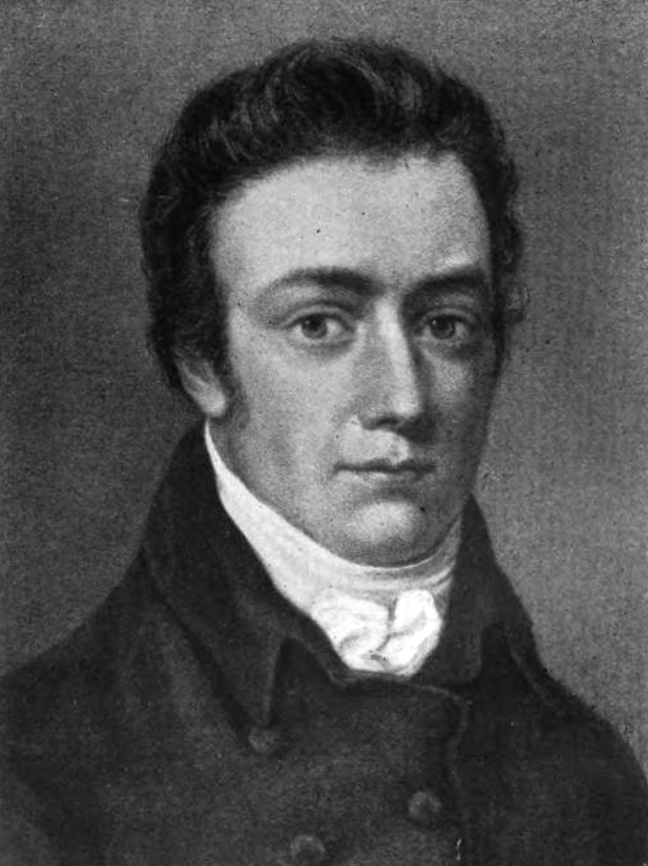
Samuel Taylor
Coleridge ( 21 October 1772 – 25 July 1834) was an English poet, literary
critic and philosopher who, with his friend William Wordsworth, was a founder
of the Romantic Movement in England and a member of the Lake Poets. He wrote
the poems The Rime of the Ancient Mariner and Kubla Khan, as well as the major
prose work Biographia Literaria. His critical work, especially on Shakespeare,
was highly influential, and he helped introduce German idealist philosophy to
English-speaking culture. Coleridge coined many familiar words and phrases, including
suspension of disbelief. He was a major influence on Emerson and American
transcendentalism.
Throughout his adult life Coleridge had
crippling bouts of anxiety and depression; it has been speculated that he had
bipolar disorder, which had not been defined during his lifetime. He was
physically unhealthy, which may have stemmed from a bout of rheumatic fever and
other childhood illnesses. He was treated for these conditions with laudanum,
which fostered a lifelong opium addiction.
"Kubla Khan"
"Kubla Khan; or, A Vision in a Dream:
A Fragment" /ˌkʊblə ˈkɑːn/ is a poem written by Samuel Taylor Coleridge,
completed in 1797 and published in 1816. According to Coleridge's Preface to
"Kubla Khan", the poem was composed one night after he experienced an
opium-influenced dream after reading a work describing
Xanadu, the summer palace of the Mongol ruler and Emperor of China Kublai Khan.
Upon waking, he set about writing lines of poetry that came to him from the
dream until he was interrupted by a person from Porlock. The poem could not be
completed according to its original 200–300 line plan as the interruption
caused him to forget the lines. He left it unpublished and kept it for private
readings for his friends until 1816 when, at the prompting of Lord Byron, it
was published.
Some of Coleridge's contemporaries
denounced the poem and questioned his story of its origin. It was not until
years later that critics began to openly admire the poem. Most modern critics
now view "Kubla Khan" as one of Coleridge's three great poems, along
with The Rime of the Ancient Mariner and Christabel. The poem is considered one
of the most famous examples of Romanticism in English poetry. A copy of the
manuscript is a permanent exhibit at the British Museum in London.
James Dickey

James Lafayette Dickey (February 2, 1923 –
January 19, 1997) was an American poet and novelist. He was appointed the
eighteenth Poet Laureate Consultant in Poetry to the Library of Congress in
1966. He also received the Order of the South award.
Edgar Allan Poe

Edgar
Allan Poe (/poʊ/; born Edgar Poe; January 19, 1809 – October 7, 1849) was an
American writer, editor, and literary critic. Poe is best known for his poetry
and short stories, particularly his tales of mystery and the macabre. He is
widely regarded as a central figure of Romanticism in the United States and
American literature as a whole, and he was one of the country's earliest
practitioners of the short story. Poe is generally considered the inventor of the
detective fiction genre and is further credited with contributing to the
emerging genre of science fiction. He was the first well-known American writer
to try to earn a living through writing alone, resulting in a financially
difficult life and career.
"The Raven"
"The Raven" is a narrative poem
by American writer Edgar Allan Poe. First published in January 1845, the poem
is often noted for its musicality, stylized language, and supernatural
atmosphere. It tells of a talking raven's mysterious visit to a distraught
lover, tracing the man's slow fall into madness. The lover, often identified as
being a student, is lamenting the loss of his love, Lenore. Sitting on a bust
of Pallas, the raven seems to further instigate his distress with its constant
repetition of the word "Nevermore". The poem makes use of a number of
folk, mythological, religious, and classical references.
"To Helen"
"To Helen" is the first of two
poems to carry that name written by Edgar Allan Poe. The 15-line poem was
written in honor of Jane Stanard, the mother of a childhood friend. It was
first published in 1831 collection Poems of Edgar A. Poe. It was then reprinted
in 1836 in the Southern Literary Messenger.

沒有留言:
張貼留言