Demi god
A demigod or demi-god is a divine or
supernatural being in classical mythology. The term has been used in various
ways at different times and can refer to a figure who has attained divine
status after death, a minor deity, or a mortal who is the offspring of a god
and a human being.
Theseus

Theseus
was the mythical king of Athens and was the son of Aethra by two
fathers: Aegeus and Poseidon.
Theseus was a founder-hero, like Perseus,
Cadmus, or Heracles (Hercules), all of whom battled and overcame foes that were
identified with an archaic religious and social order. As Heracles was the
Dorian hero, Theseus was a founding hero, considered by Athenians as their own
great reformer: his name comes from the same root as θεσμός
("thesmos"), Greek for "The Gathering". The myths
surrounding Theseus—his journeys, exploits, and family—have provided material
for fiction throughout the ages.
Theseus was responsible for the synoikismos
("dwelling together")—the political unification of Attica under
Athens, represented emblematically in his journey of labours, subduing ogres
and monstrous beasts. Because he was the unifying king, Theseus built and occupied
a palace on the fortress of the Acropolis that may have been similar to the
palace that was excavated in Mycenae. Pausanias reports that after the
synoikismos, Theseus established a cult of Aphrodite Pandemos ("Aphrodite
of all the People") and Peitho on the southern slope of the Acropolis.
Plutarch's vita (a literalistic biography)
of Theseus makes use of varying accounts of the death of the Minotaur, Theseus'
escape, and the love of Ariadne for Theseus. Plutarch's sources, not all of
whose texts have survived independently, included Pherecydes (mid-fifth century
BC), Demon (c. 400 BC), Philochorus, and Cleidemus (both fourth century BC).
Hercules
Hercules is the Roman name for the Greek
divine hero Heracles, who was the son of Zeus (Roman equivalent Jupiter) and
the mortal Alcmene. In classical mythology, Hercules is famous for his strength
and for his numerous far-ranging adventures.
The Romans adapted the Greek hero's
iconography and myths for their literature and art under the name Hercules. In
later Western art and literature and in popular culture, Hercules is more
commonly used than Heracles as the name of the hero. Hercules was a
multifaceted figure with contradictory characteristics, which enabled later
artists and writers to pick and choose how to represent him. This article
provides an introduction to representations of Hercules in the later tradition.
Hercules is known for his many adventures,
which took him to the far reaches of the Greco-Roman world. One cycle of these
adventures became canonical as the "Twelve Labours," but the list has
variations.
Eros
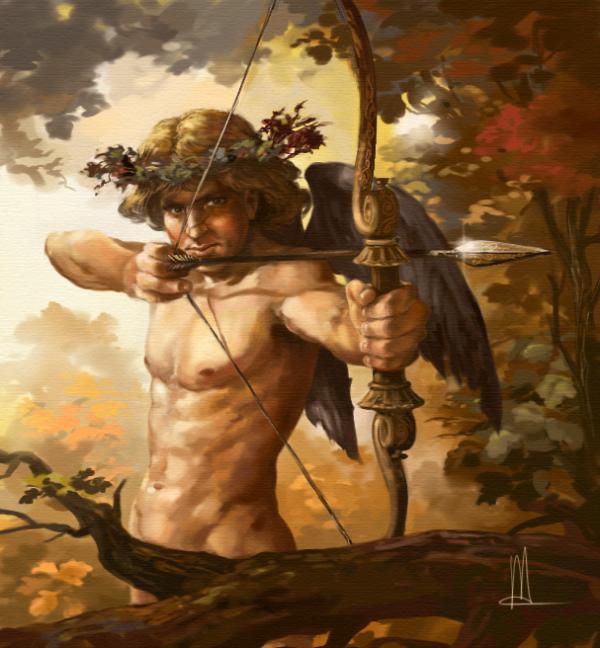
In Greek mythology, Eros was the Greek god of love. His Roman
counterpart was Cupid ("desire"). Some myths make him a primordial
god, while in other myths, he is the son of Aphrodite. He was one of the winged
love gods, Erotes.
Eros appears in ancient Greek sources under
several different guises. In the earliest sources (the cosmogonies, the
earliest philosophers, and texts referring to the mystery religions), he is one
of the primordial gods involved in the coming into being of the cosmos. But in
later sources, Eros is represented as the son of Aphrodite, whose mischievous
interventions in the affairs of gods and mortals cause bonds of love to form,
often illicitly. Ultimately, in the later satirical poets, he is represented as
a blindfolded child, the precursor to the chubby Renaissance Cupid, whereas in
early Greek poetry and art, Eros was depicted as an adult male who embodies
sexual power, and a profound artist.
A cult of Eros existed in pre-classical
Greece, but it was much less important than that of Aphrodite. However, in late
antiquity, Eros was worshiped by a fertility cult in Thespiae. In Athens, he
shared a very popular cult with Aphrodite, and the fourth day of every month was
sacred to him
A Midsummer Night's Dream
A Midsummer Night's Dream is a comedy
written by William Shakespeare sometime between 1590 and 1597. It portrays the
events surrounding the marriage of Theseus, the Duke of Athens, to Hippolyta.
These include the adventures of four young Athenian lovers and a group of six
amateur actors (the mechanicals) who are controlled and manipulated by the
fairies who inhabit the forest in which most of the play is set. The play is
one of Shakespeare's most popular works for the stage and is widely performed
across the world.

沒有留言:
張貼留言