Achilles's Heel
An Achilles' heel is a weakness in spite of overall strength, which can
actually or potentially lead to downfall. While the mythological origin refers
to a physical vulnerability, idiomatic references to other attributes or
qualities that can lead to downfall are common.
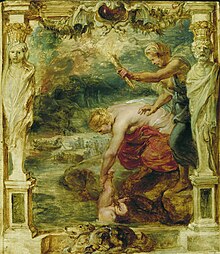
ü Origin:
In Greek mythology, when Achilles was a baby, it was foretold that he would die
young. To prevent his death, his mother Thetis took Achilles to the River Styx,
which was supposed to offer powers of invulnerability, and dipped his body into
the water. But as Thetis held Achilles by the heel, his heel was not washed
over by the water of the magical river. Achilles grew up to be a man of war who
survived many great battles. But one day, a poisonous arrow shot at him was
lodged in his heel, killing him shortly after.
Pomegranate

In
Ancient Greek mythology, the pomegranate was known as the "fruit of the
dead", and believed to have sprung from the blood of Adonis.
The
myth of Persephone, the goddess of the underworld, prominently features the
pomegranate. In one version of Greek mythology, Persephone was kidnapped by
Hades and taken off to live in the underworld as his wife. Her mother, Demeter
(goddess of the Harvest), went into mourning for her lost daughter, thus all
green things ceased to grow. Zeus, the highest-ranking of the Greek gods, could
not allow the Earth to die, so he commanded Hades to return Persephone. It was
the rule of the Fates that anyone who consumed food or drink in the underworld
was doomed to spend eternity there. Persephone had no food, but Hades tricked
her into eating six pomegranate seeds while she was still his prisoner, so she
was condemned to spend six months in the underworld every year. During these
six months, while Persephone sits on the throne of the underworld beside her
husband Hades, her mother Demeter mourns and no longer gives fertility to the
earth. This was an ancient Greek explanation for the seasons.
The Three Fate
 In
Greek mythology, the Moirai or Moerae, often known in English as the Fates
(Latin: Fatae), were the white-robed incarnations of destiny. They
controlled the mother thread of lifestyle of every mortal from birth to death.
They were independent, at the helm of necessity, directed fate, and watched
that the fate assigned to every being by eternal laws might take its course
without obstruction.
The Three Fate
Destiny vs. Fate
- Both refer to a man's future and fortune.
- Fate is seen as divinely planned, whereas destiny has the power to be influenced by man's actions.
- Fate comes from the three sisters of Greek mythology who preordain the lives of all men while destiny is seen in more humanistic concepts such as predestination.
- Fate is often pessimistic or fatalistic about one's fortune whereas destiny is more upbeat and willing to take a chance for betterment.
Golden
apple
Zeus
held a banquet in celebration of the marriage of Peleus and Thetis. Eris, the
goddess of discord, was not invited for her troublesome nature, and upon
turning up uninvited, she threw a golden apple into the ceremony, with an
inscription that read:"for the most beautiful" . Three goddesses
claimed the apple: Hera, Athena, and Aphrodite. They brought the matter before
Zeus. Not wanting to get involved, Zeus assigned the task to Paris of Troy.
Paris had demonstrated his exemplary fairness previously when he awarded a
prize unhesitatingly to Ares after the god, in bull form, had bested his own
prize bull.
Zeus
gave the apple to Hermes and told him to deliver it to Paris and tell him that
the goddesses would accept his decision without argument. As each goddess
wanted to receive the apple, they each stripped off their own clothing and
appeared naked before Paris. Each of the goddesses also offered Paris a gift as
a bribe in return for the apple; Hera offered to make him the king of Europe
and Asia, Athena offered him wisdom and skill in battle, and Aphrodite offered
him the most beautiful woman in the world as his wife, Helen of Sparta. Paris
chose Aphrodite, a decision that ultimately led to the start of the Trojan war.
Paris soon went to celebrate the marriage of Helen and Menelaus with his
brother. They spent the night there, and Menelaus was called to Agamemnon, and
thus Helen and Paris were left alone. In this time they made love, and Helen
left Menelaus to sail to Troy with Paris, thus initiating the Trojan War.
Femme
fatale
A
femme fatale is a stock character of a mysterious and seductive woman whose
charms ensnare her lovers, often leading them into compromising, dangerous, and
deadly situations.
Salome

Salome has become a symbol for dangerous female seductiveness. Her dance before Herod, or with the head of John the Baptist.
Helen

ü Meaning:A
reference to the mythological figure Helen of Troy (or some would say, to
Aphrodite). Her abduction by Paris was said to be the reason for a fleet of a
thousand ships to be launched into battle, initiating the Trojan Wars.
ü Origin:
Christopher
Marlowe, in Doctor Faustus (variously dated between 1590 and 1604), referring
to Helen of Troy, or as Marlowe had it 'Helen of Greece':
Was
this the face that launch'd a thousand ships
And
burnt the topless towers of Ilium?
Sweet
Helen, make me immortal with a kiss.


Ceres

Ceres was
a goddess of agriculture, grain crops, fertility and motherly relationships.
Telemachus
is a figure in Greek mythology, the son of Odysseus and Penelope, and a central
character in Homer's Odyssey.
Nausicaa
She
is the daughter of King Alcinous and Queen Arete of Phaeacia. Her name, in
Greek, means "burner of ships".
Odysseus
is shipwrecked on the coast of the island of Scheria. Nausicaa and her
handmaidens go to the sea-shore to wash clothes. Awoken by their games,
Odysseus emerges from the forest completely naked, scaring the servants away,
and begs Nausicaa for aid. Nausicaa gives Odysseus some of the laundry to wear,
and takes him to the edge of the town. Realizing that rumors might arise if
Odysseus is seen with her, she and the servants go ahead into town. But first
she advises Odysseus to go directly to Alcinous' house and make his case to
Nausicaa's mother, Arete. Arete is known as wiser even than Alcinous, and
Alcinous trusts her judgment. Odysseus follows this advice, approaching Arete
and winning her approval, and is received as a guest by Alcinous. During his
stay, Odysseus recounts his adventures to Alcinous and his court. This
recounting forms a substantial portion of the Odyssey. Alcinous then generously
provides Odysseus with the ships that finally bring him home to Ithaca.
Nymth
Nymth


A
nymph in Greek mythology and in Latin mythology is a minor female nature deity
typically associated with a particular location or landform. Different from
other goddesses, nymphs are generally regarded as divine spirits who animate
nature, and are usually depicted as beautiful, young nubile maidens who love to
dance and sing; their amorous freedom sets them apart from the restricted and
chaste wives and daughters of the Greek polis.

沒有留言:
張貼留言